 Skip-the-line available
 Barragán beyond the house: planning a Mexico City architecture day
Casa Ortega next door, Casa Gilardi, the Capuchinas chapel, the Pedregal, Satélite and the San Cristóbal stables, and how to fit them around your visit.
Casa Luis Barragán is the place to start with Barragán, but it is not the only building of his you can see in Mexico City. Several of his houses, a chapel, a garden suburb, a set of towers and a horse estate are spread around the metropolitan area, and a few of them can be visited. They are not close together, they each have their own booking arrangements, and Mexico City traffic is slow, so seeing more than one or two in a day takes planning. This guide describes the main works, what makes each worth the trip, and how to build a day around your visit to the house.
Start with the house
If you only see one Barragán building, make it his own. Casa Luis Barragán is the work he lived in for 40 years, it is listed by UNESCO, and it shows every idea he developed elsewhere in one place. It also sets the rhythm of your day, because it is the hardest of his works to book and the one with the strictest timetable.
The house closes at 15:00 from Monday to Thursday and at 14:00 on Saturday, and it is closed on Sundays. So your visit will be in the morning or around midday. Book it first, then build the rest of the day around the time you get. Self-guided visits run on Monday, Wednesday, Thursday and Saturday; guided tours on Monday, Tuesday and Friday.
The house's own visitor page lists five other Barragán properties that can be visited, each by separate arrangement: Casa Ortega, Casa Gilardi, Casa Pedregal, the Capilla de las Capuchinas and the Cuadra San Cristóbal. None of them is included in a Casa Luis Barragán ticket, and none is booked through us. Check each one's own visiting days and terms before you plan around it.
Casa Ortega, next door
The easiest addition to your day is right beside you. Casa Ortega stands on the neighbouring lot on General Francisco Ramírez, and it was Barragán's own home before he built the house you are visiting. He bought the land in 1940, built this first house in the early 1940s, and lived in it until he moved next door. It later passed to the Ortega family, after whom it is named.
The two houses once formed one property, and their gardens were connected. Seeing Casa Ortega shows Barragán at a turning point, moving away from the European modernism of his first Mexico City years towards the inward-looking, walled architecture of his own house. It is visited by appointment through its own organisers, so check whether a visit can be arranged for your day before you count on it.
What to look at on the street
Before or after your visit, take ten minutes on General Francisco Ramírez itself. The street is ordinary, which is the point: Barragán built his house in a working neighbourhood and gave it a face that hardly stands out.
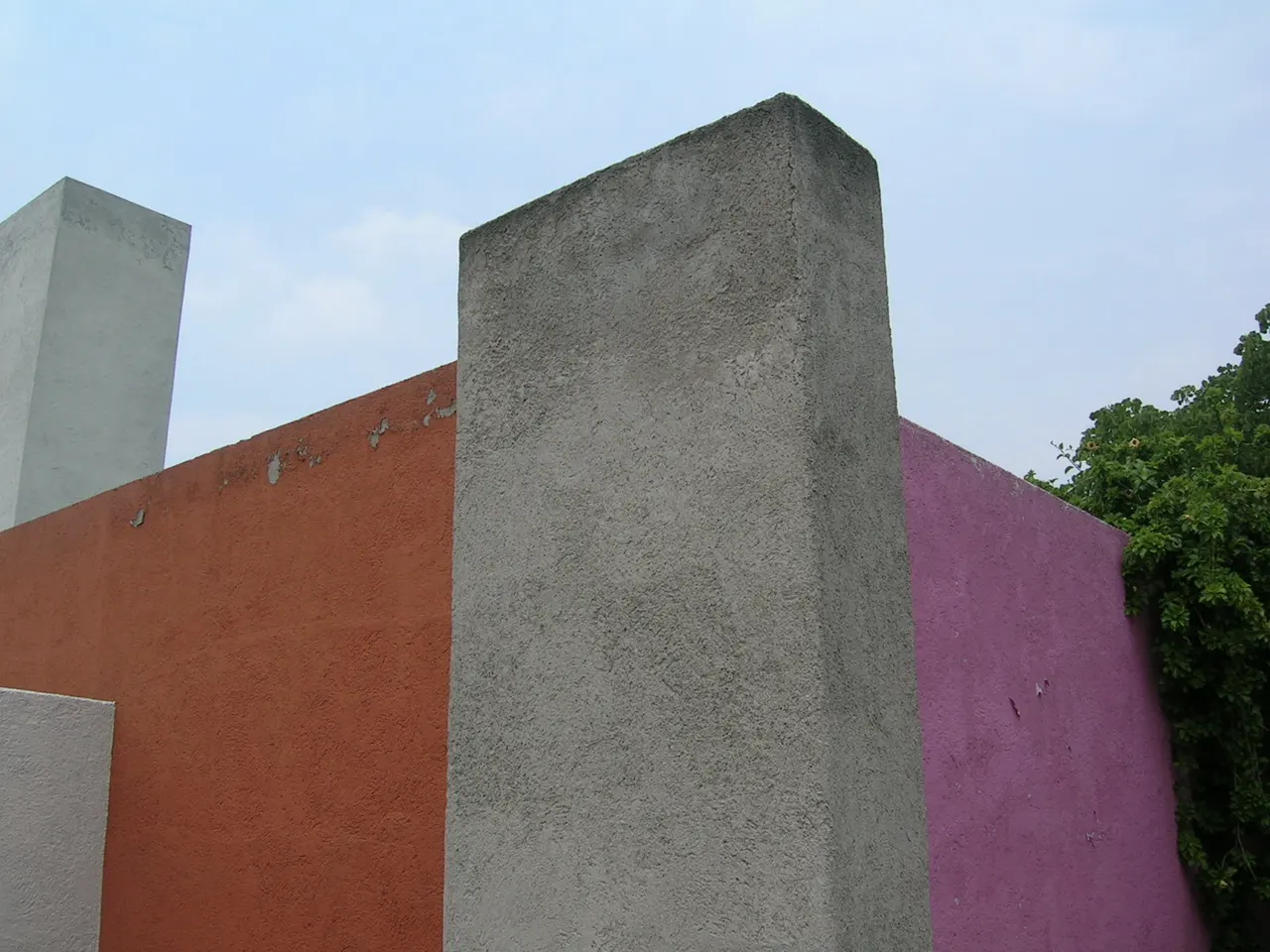
Look for the two doors of the house, number 14 for the residence and number 12 for the workshop to the north. Look up at the translucent library window projecting from the wall, at the yellow and orange planes meeting on the upper corner, and at the white water tower rising over the roofline. A World Heritage plaque on the façade marks the listing. Then look along the street at the house next door, Casa Ortega, Barragán's earlier home, with its own plain front.
None of this needs a ticket, and it is the best way to understand how much the house keeps hidden.
Casa Gilardi
Casa Gilardi is the last work Barragán completed himself, finished in the mid-1970s in the San Miguel Chapultepec neighbourhood, not far from Tacubaya. From the street it is a narrow town house with a pink front. Inside, it is famous for a corridor lit through yellow glass and an indoor pool where a column of red and a wall of blue rise straight out of the water, lit through a slot in the ceiling.
If the house in Tacubaya is Barragán at home, Casa Gilardi is Barragán at the height of his colour. It is still a private home, visited by arrangement through its own organisers. Because it is in the same part of the city as Casa Luis Barragán, it is the most natural second visit on the same day, if the times allow.
The Capuchinas chapel in Tlalpan
In the 1950s Barragán remodelled the convent chapel of the Capuchin nuns in Tlalpan, in the south of the city. He worked on it with Mathias Goeritz, whose gold triptych stands at the altar. The chapel is small and plain, and its effect depends almost entirely on light: coloured light falling across the walls and floor, and gold catching it at the altar.
It is a working convent, so visits are arranged through the nuns themselves and are limited. Tlalpan is a long way south of Tacubaya, so treat the chapel as a separate outing rather than an afternoon add-on.
Casa Pedregal and the Jardines del Pedregal
Between 1945 and 1952 Barragán developed the Jardines del Pedregal de San Ángel in the south of the city, on a field of black volcanic rock. Instead of clearing the lava, he designed gardens, walls and plazas around it. The development has changed a great deal since then, but the idea of building with the rock rather than against it shaped his later work, including the volcanic stone floor of his own entrance hall.
One of the houses he designed there has been restored and is known today as Casa Pedregal. It can be visited by arrangement through its own organisers. If you are interested in Barragán the landscape architect, this is the place to see it.
Torres de Satélite
The Torres de Satélite are the most public of Barragán's works: five tall, triangular concrete towers in bright colours, designed with Mathias Goeritz in 1957 and 1958 as the emblem of the new Ciudad Satélite development on the north-western edge of the metropolitan area. They stand in the middle of a busy highway and were meant to be seen from a moving car.
There is no ticket and no visit in the usual sense. You see them as you drive past, or from the surrounding streets. If your route north-west takes you near them, they are worth the detour. If it does not, they are a long way to go for a look.
Cuadra San Cristóbal
Between 1966 and 1968 Barragán designed the Cuadra San Cristóbal at Los Clubes, a horse estate on the north-western edge of the metropolitan area, together with the Egerstrom house. It is the work most people picture when they think of Barragán's colour: pink and purple walls, long pools of water for the horses, and openings framed for horses and riders rather than people on foot.
It is a private estate, and visits are arranged through its own organisers. It is far from Tacubaya, so plan it as a separate half-day or combine it with the Torres de Satélite, which are in the same general direction.
Further afield: Guadalajara
If your travels take you to Guadalajara, Barragán's home city, you can see the other end of his career. His first houses were built there in the late 1920s and early 1930s, and he later designed the Jardines del Bosque garden suburb in the city in 1955, and the El Palomar development nearby. These are less often visited and mostly private, but walking past the early houses shows where his ideas began.
How to plan the day
Book Casa Luis Barragán first. Its tickets are the hardest to get and the timetable is the strictest, so everything else fits around it. Once you know your date and time, look at what else can be arranged for the same day.
The simplest combination is the house plus Casa Ortega next door, or the house plus Casa Gilardi in the same part of the city, if their visiting times line up. A morning entry at Casa Luis Barragán leaves the afternoon for one more visit.
Southern works such as the Capuchinas chapel and Casa Pedregal, and north-western ones such as the Cuadra San Cristóbal and the Torres de Satélite, are best kept for other days. They are far apart, traffic is heavy, and each needs its own arrangement.
Allow more travel time than the map suggests. The house itself warns that moving around Mexico City can be extremely slow, and it is strict about entry times: self-guided visitors who arrive late wait for a later time with space, and nobody is let in during the last 30 minutes before closing.
A sample day
Here is one way a Barragán day can work, assuming the times line up. Book a self-guided or guided visit at Casa Luis Barragán for late morning. Arrive early, browse the bookshop while you wait, and take your time inside. Afterwards, walk along General Francisco Ramírez to see the plain street fronts of both houses from the outside, and if a visit to Casa Ortega has been arranged, go next door.
In the afternoon, cross to San Miguel Chapultepec for Casa Gilardi, if its visiting times allow, to see the colour of Barragán's last work after the quiet of his own house. End the day with no more appointments. Two of his buildings in one day is plenty, and most people find the second visit means more after the first.
Keep the southern and north-western works for other days, and treat each as an outing of its own.
Getting to Casa Luis Barragán
The house is at General Francisco Ramírez 12, in the Ampliación Daniel Garza neighbourhood of the Miguel Hidalgo borough, in old Tacubaya. There is no parking at the house. The nearest Metro station is Constituyentes on Line 7, the orange line. The nearest Metrobús stop is Parque Lira on Line 2, the purple line. There is an Ecobici bike-share station nearby, number 188, and the 34-A Ecobús route stops close by.
The bookshop at the house is open without a museum ticket, Monday to Friday 11:00 to 17:00 and on Saturday 11:00 to 14:00. It sells books and objects about Barragán and architecture, and it is a good place to wait if you arrive early.
Frequently asked
Which other Barragán buildings can I visit in Mexico City?
The house's own visitor page lists Casa Ortega, Casa Gilardi, Casa Pedregal, the Capilla de las Capuchinas and the Cuadra San Cristóbal. Each is visited by separate arrangement, not with a Casa Luis Barragán ticket.
Can I see Casa Gilardi on the same day as Casa Luis Barragán?
Often, yes. It is in the same part of the city, and a morning or midday visit to the house leaves the afternoon free, if Casa Gilardi's own visiting times fit.
Is Casa Ortega the same as Casa Luis Barragán?
No. Casa Ortega is the house next door, Barragán's earlier home on the same street. It is visited separately, by its own arrangement.
Can I visit the Torres de Satélite?
They are public sculptures in the middle of a highway on the north-western edge of the city, so you see them from the road. There is no visit or ticket.